Cloud & DevOps Engineering
for Mid-Market Enterprises

A cloud migration that only moves servers moves your problems with them. We containerise workloads, put infrastructure in code so environments stop drifting, and build CI/CD that makes a deploy boring — then tune what you actually pay for, because right-sizing and autoscaling are where the migration business case is usually won or lost.

The problem

Most migrations move the problems too

Lifting servers onto someone else's hardware changes the invoice, not the operating model. The deploys are still manual, the environments still drift, and the bill arrives larger than the one it replaced. We migrate the way you work, not just where it runs.

Releases thatstop being events

Environmentsthat don't drift

Spend tied toactual load
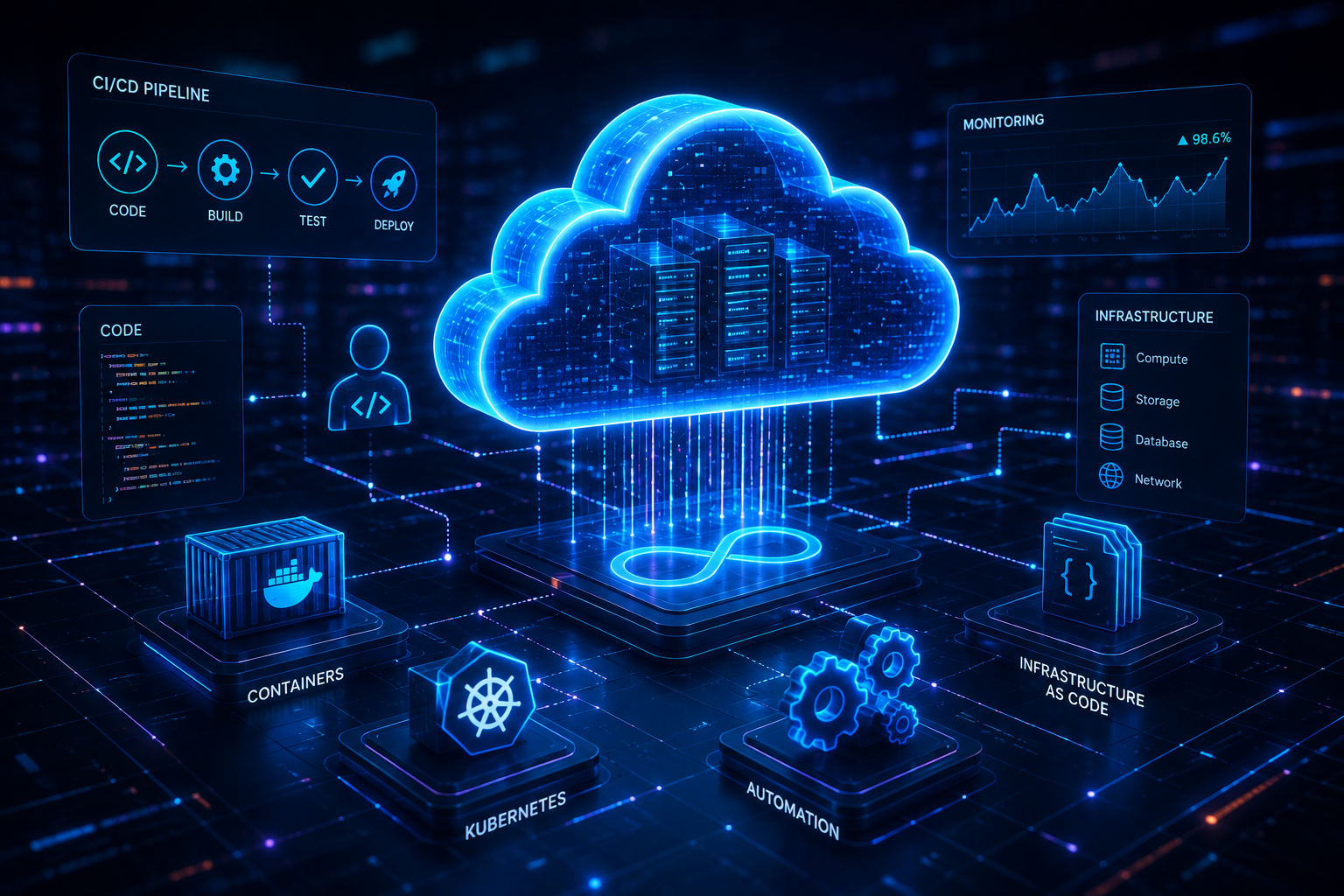
Boring deploys.Predictable bills.

Lift and shift

rarely pays for itself

Rehosting without re-architecting typically raises run costs — you keep paying for peak capacity you only need occasionally, now at cloud rates.

Drift

is what breaks releases

When staging and production are configured by hand, they diverge quietly. The deploy that fails is usually the first one to notice.

Our fix

automate before you migrate

Infrastructure in code and a pipeline that proves itself on every commit, so the move is a rehearsed step rather than a weekend everyone dreads.

Cloud & DevOps Solutions

Cloud Migration & Deployment:

We inventory dependencies first, then move workloads to AWS, Azure or GCP in rehearsed waves, running old and new side by side until the new path is verified.

Infrastructure as Code

Every environment defined in Terraform and provisioned from version control, so staging and production are rebuilt from the same source instead of drifting apart by hand.

Continuous Integration & Continuous Delivery (CI/CD):

Pipelines that build, test and promote a versioned artifact on every commit, with an automated rollback path so a bad release is reverted rather than debugged live.

Cloud Security Assessment

Configuration and IAM review across AWS, Azure and GCP: public exposure, over-broad roles, unencrypted storage and missing guardrails, returned as policy you can apply as code.

Containerization & Orchestration

Applications containerised with Docker and run on Kubernetes with health checks, resource limits and autoscaling set deliberately, not left at whatever the defaults were.

Monitoring & Optimization

Metrics, logs and alerting your team owns, alongside right-sizing and idle-environment cleanup so what you pay tracks the load you actually serve.

What changes

Outcomes we hold ourselves to

Every engagement starts by agreeing which of these numbers we're moving, and how we'll measure it. Ranges below reflect what our cloud and DevOps engagements have delivered — your starting point determines where you land.

Days to minutes

release lead time

From a change being ready to it running in production, once the pipeline replaces the hand-offs and the change-window queue.

20–40%

lower monthly cloud spend

From right-sizing, autoscaling and killing idle non-production environments — measured against your own pre-migration baseline.

Minutes, not hours

to recover from a bad deploy

Versioned artifacts and a rehearsed rollback path, so a failed release is reverted rather than debugged live.

Zero-touch

environment rebuilds

Any environment recreated from code on demand, which is what stops staging and production drifting apart in the first place.

How we work

Three ways to start

Cloud programmes usually go wrong when the shape of the engagement never matched how much was actually known up front. Pick the one that fits what you know today; moving between them mid-programme is normal.
Migration & automation build

For a defined estate with a clear target platform and an agreed cutover plan.

  • Infrastructure as code and CI/CD built before anything moves
  • Workloads containerised and migrated in rehearsed waves
  • Full handover, including monitoring, alerting and runbooks

Timeline

8–16 weeks, fixed scope

Best for

A known, bounded estate

Trust & compliance

Built to survive an audit

Infrastructure that handles regulated data needs more than uptime. Governance is designed in from the first sprint rather than retrofitted when a review is scheduled.

Aligned to

GDPR
HIPAA
SOC 2
ISO 27001
PCI DSS

Data residency and isolation

Workloads run in your own cloud accounts and chosen regions, with network boundaries and tenancy documented rather than assumed.

Least privilege by default

Identity and access policies defined as code and reviewed like any other change, so permission creep shows up in a diff instead of an audit.

Every change on record

Infrastructure changes arrive through version control and CI, which means the audit trail your reviewers ask for is a by-product of how we work.

Recovery you've actually tested

Backup and disaster-recovery paths exercised on a schedule, with the measured restore time written down rather than estimated.

Not automatically — and anyone promising that up front is guessing. Simply rehosting what you have often costs more, because you keep paying for peak capacity at cloud rates. The savings come from right-sizing, autoscaling and shutting down idle environments. We put your current spend next to a projected bill during the assessment, so you see the real number before committing.

Yes, in almost all cases. We move workloads in waves rather than all at once, run the old and new side by side while we verify the new path, and rehearse the cutover before the real one. Anything that genuinely needs downtime gets flagged early, with the window agreed rather than sprung on you.

No. Plenty of estates are better off staying hybrid, and some workloads shouldn't move at all — for licensing, latency or compliance reasons. We use managed services where they clearly earn their place and keep the rest portable, so a future move is a project rather than a rebuild.

They end up owning it. Your engineers work alongside ours while we build rather than being handed a finished platform, and we walk them through how it works — and how it fails — before we leave. The goal is that nothing depends on us to keep running.

It's the normal starting point. Mapping what you actually have, including the parts nobody remembers configuring, is the first thing the assessment does. We'd rather tell you early that something needs re-architecting than discover it halfway through a cutover.

BMI

Building intelligent digital products across AI, security, and cloud.

© 2026 BMI. All Rights Reserved.